Amir Washington · 5 November 2026
Community Art Murals Draw From Digitized Farm Records to Celebrate Recent Orchard Harvests and Bird Sightings
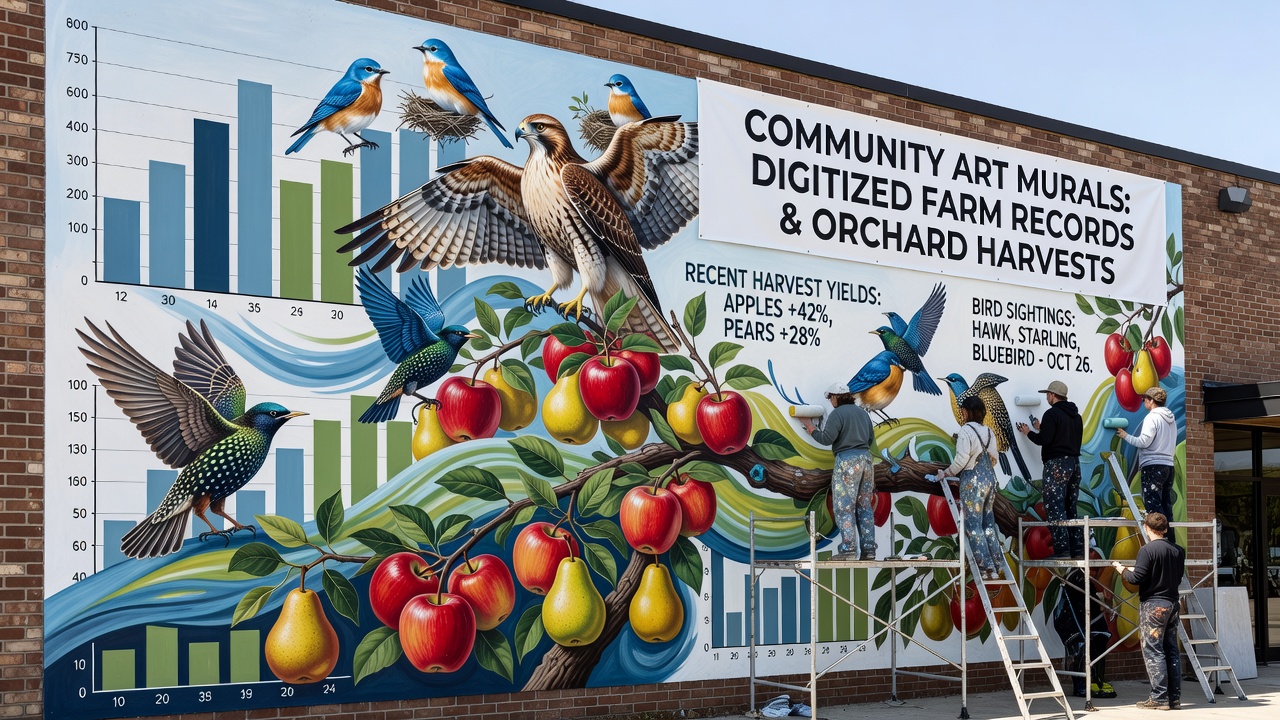
Local artists in Birch Hill have turned to digitized agricultural ledgers from the early twentieth century to design a series of murals that highlight both recent orchard yields and documented bird observations in the area. These projects began gaining momentum in the fall of 2026, with several installations completed ahead of November community events that drew residents together to view the finished works. The records, now accessible through public databases, contain detailed entries on apple and pear harvests along with notes on species such as cedar waxwings and northern flickers that frequented the orchards during those decades.
Digitization Efforts Open Historical Data to Artists
Teams at regional archives completed the digitization of farm ledgers spanning 1905 through 1955, and this work allowed illustrators to cross-reference yield figures with seasonal bird counts recorded by landowners. One project coordinator explained that the data sets showed consistent patterns where higher fruit production years aligned with increased sightings of migratory flocks, a correlation that informed the color palettes and compositional choices for the murals. Artists selected specific ledger entries mentioning bumper crops in 1923 and 1947 to anchor central panels, while surrounding sections incorporated sketches of bird species noted in the same volumes.
Mural Locations and Themes in Birch Hill
Five walls across the town center received new artwork between September and November 2026, each measuring roughly twelve feet by eight feet and executed in weather-resistant acrylics. The themes rotate between harvest abundance and avian presence, with one panel showing stacked crates of apples beneath branches occupied by foraging robins. Another depicts rows of pear trees at dusk alongside silhouettes of owls that the original farmers logged as regular visitors. Local volunteers assisted with surface preparation, and the process followed guidelines issued by municipal heritage offices to ensure the surfaces remained suitable for future community projects.
Integration of Recent Harvest and Sighting Data
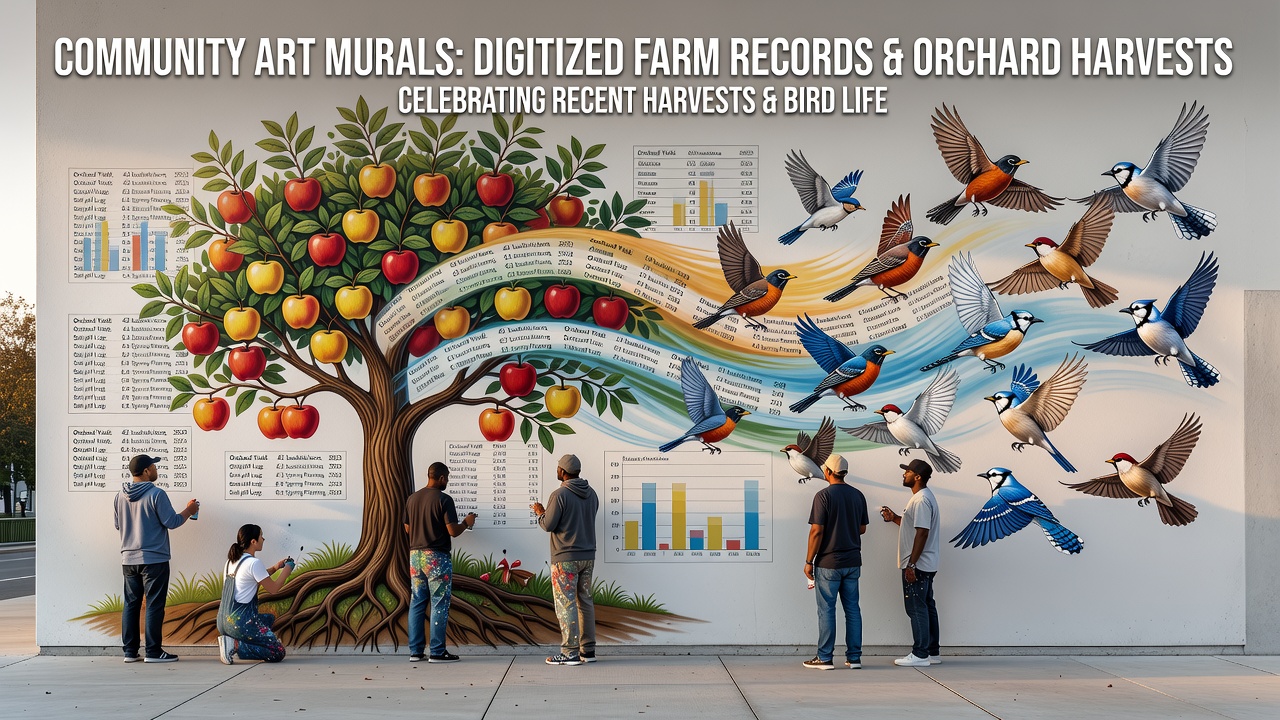
While the murals draw visual inspiration from the older documents, they also incorporate updated statistics gathered during the 2025 and 2026 growing seasons. Cooperative extension offices supplied figures indicating a 12 percent increase in total orchard output compared with the five-year average, and bird observation networks reported steady populations of the same species noted a century earlier. Artists blended these contemporary numbers into border motifs that list exact harvest weights and sighting dates, creating a timeline that connects past and present without altering the original aesthetic of the ledger pages.
Community Participation and Educational Components
Workshops held in October 2026 invited residents to review printed excerpts from the digitized records before the murals received their final coats of sealant. Participants contributed personal family stories about specific trees or bird nests, and several of those anecdotes appear as small inset illustrations on the lower edges of two panels. School groups visited the sites during the first week of November, using the artwork as a prompt for lessons on local ecology and historical record-keeping practices. Attendance logs from those sessions show more than 180 students took part across three days.
Technical Aspects of the Artwork Production
Preparatory work included digital scanning of each relevant ledger page at 600 dpi resolution, followed by color correction to match the faded ink tones visible in the originals. Painters then projected enlarged versions onto the walls and traced key elements before applying paint in layers that build from background washes to fine detail. Protective coatings rated for ultraviolet exposure and freeze-thaw cycles were applied in late October to safeguard the surfaces through the coming winter months. The entire sequence followed conservation standards referenced in publications from the Canadian Conservation Institute, which emphasize reversible materials on historic building exteriors.
Broader Context of Agricultural Archives in Public Art
Similar initiatives have appeared in other agricultural regions where digitized farm data informs public installations. According to reports from the United States Department of Agriculture, several Midwest counties have used comparable record sets to create interpretive signage along harvest trails. In Australia the Department of Agriculture, Fisheries and Forestry has supported projects that translate yield statistics into large-scale graphics displayed at regional markets. These examples illustrate a pattern where historical agricultural documentation serves both educational and decorative purposes when made available through open-access platforms.
Conclusion
The Birch Hill murals stand as one outcome of sustained efforts to preserve and reinterpret farm records that once existed only on paper. By November 2026 the completed installations had already become gathering points for residents interested in the overlap between agricultural history and local wildlife patterns. The approach demonstrates how archived data can move from storage facilities into shared public spaces while retaining factual accuracy in both content and presentation. Future phases of the project may expand to additional walls once the next round of digitization concludes.